
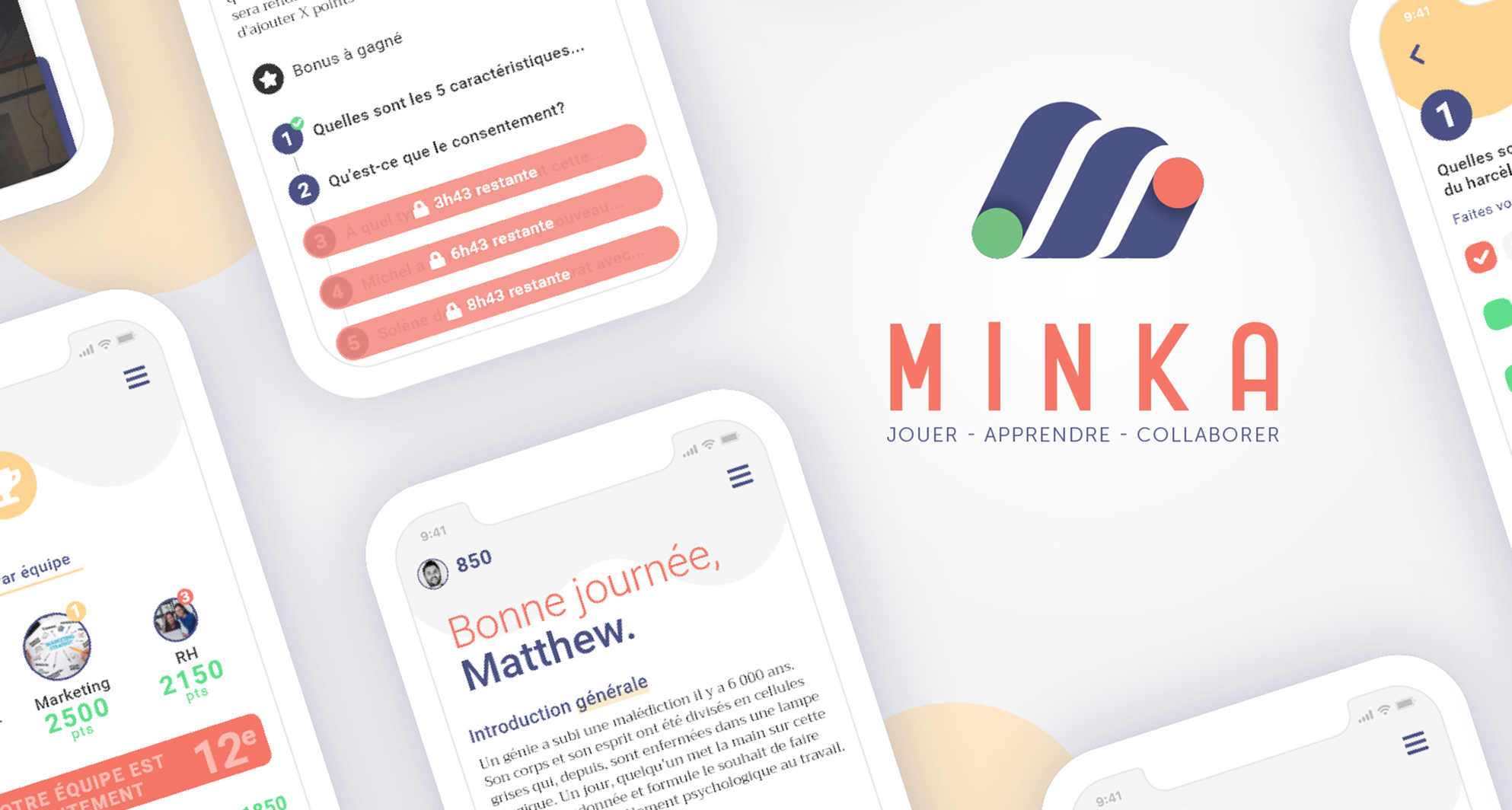
Minka, a Serious Game Example Showing the Gamification of Learning.
Minka, a serious game for learning
Why do games have a childish connotation? Is it adulthood snobbery to want to relegate games to mere entertainment? It’s quite possible, but if we look beyond this connotation, games have a lot to offer us, especially in skills development.
At Novaconcept, we are convinced that games are a very serious lever for learning in business. This is why we developed MINKA, a collaborative and educational gaming platform. How does it work in two sentences? The learners grouped into rival teams answer a series of questions organized by level. Jokers and bonuses help and spice up their respective courses. In short, the MINKA platform is based on a playful and fragmented learning approach.
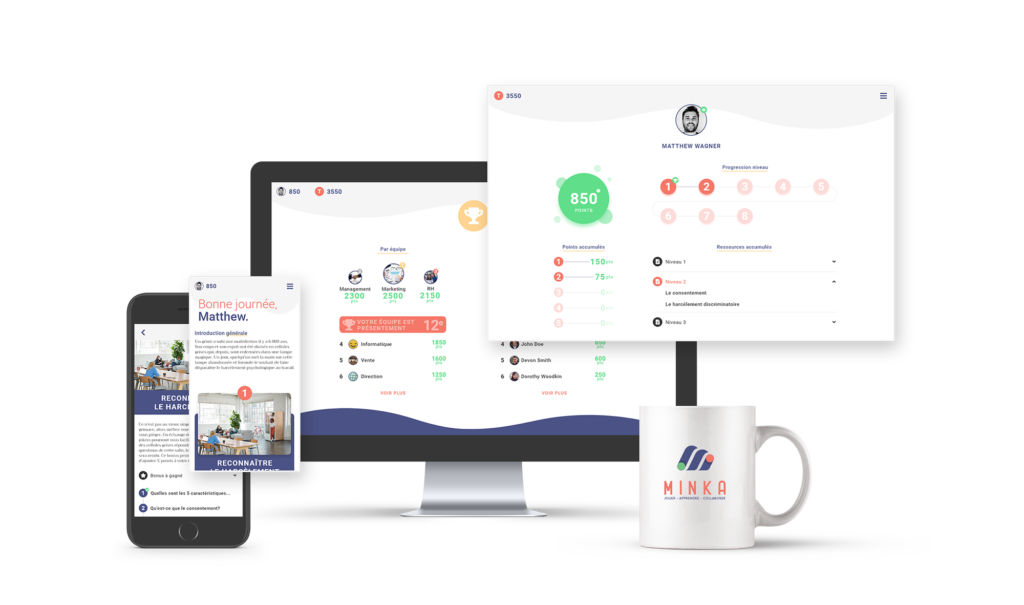
Almost convinced of the approach? Here is our reasoning.
Acquiring new skills is a process that requires the learner to invest. It’s an investment in time and concentration that pays little in the short term, but whose results are more obvious in the medium and long term. The simple will to learn for the sake of learning is often strained by the accomplishment of everyday tasks. Motivation and energy are lacking when it comes to training.
What if, to motivate employees, you had to tap into another register and seek commitment in another form? A form where the reward is more immediate, where the positive reinforcement effect pushes for continuous improvement. Games have the ability to awaken motivation and make us think twice.
This is known in technical jargon as “gamification,” that is to say the addition of design and game mechanisms to contexts that are usually devoid of them.
Online training is particularly conducive to gamification, as connections with the video game world can easily be made. For our collaborative and educational platform, we have relied on two well-known game mechanisms to generate engagement: collaboration and competition.
- Collaboration motivates learners in that it spontaneously creates a feeling of belonging and a strong team spirit.
- Competition, for its part, seeks the motivation of learners who want to measure themselves against their game opponents and obtain positive results.
Finally, let’s not forget that motivation has a time dimension. Just like concentration, learner motivation decreases when subjected to time: therefore the more time passes, the less learners are motivated.
The solution: break the content into bite-size pieces so as not to give learners time to lose their appetite for learning. The benefits of fragmentation don’t end there; it also contributes to better retention of content in learners.
A study1 has shown that a group exposed to content cut into several pieces, interspersed with questions, performs better than a group exposed to the same content, presented in a block and followed by the same number of questions. Afterwards, an evaluation was conducted and found that the group of learners subjected to the fragmented content recorded a success 20% higher than the other group, while taking 28% less time to complete the evaluation. It’s pretty significant, don’t you think?
Far from being childish, games know how to captivate, mobilize and motivate. These are qualities that we want to use for the development of skills within companies.
To learn more about Minka, visit the link below or contact us at : minka@wp225906.wpdns.ca
References
(1) Kapp, F., Proske, A., Narciss, S., & Körndle, H. (2015). Distributing vs. blocking learning questions in a web-based learning environment. Journal of Educational Computing Research, 51(4), 397-416. doi:10.2190/EC.51.4.b


How Much Does it Cost to Create a E-learning Course?
I am often asked: “How much does it cost to design and produce a 30-minute online course?” To that, I always answer the same thing: “How much does a 30-second ad on TV cost?” You will therefore understand that it depends on a multitude of factors…
I therefore suggest three questions to ask yourself to determine your e-learning budget.
First question, how do you plan to allocate the necessary resources?
There are many ways to collaborate with e-learning experts, and depending on your internal resources, availability, and timeline, you may choose to outsource the design or part of it to us. Some clients provide us with their own script, for review or not, while other clients often hire our instructional designers to produce a script from raw content.
Now, what is the desired level of interactivity?
Depending on whether the course objectives are formative or informative, you must determine the desired level of interactivity. Interactivity can be:
• non-existent, with strictly linear animated content,
• limited, with a menu and multiple choice questions, for example,
• moderate, we are talking about essay questions, connection, integration of elements of varied content,
• or immersive, with custom feedback, simulations, avatars, etc.
Of course, our experts are there to guide you in this decision and ensure that the chosen format serves the content well, but it is important that this decision be made ahead of the project since it has a significant impact on the budget. With this information in hand, you are now able to answer the following question: what is the production’s complexity level?
The production includes scriptwriting, graphic design, integration and programming. A variety of elements impact the complexity level. They include:
- the content level (from simple to expert),
- graphic elements (use of existing equipment versus development of custom graphic elements),
- navigation needs (linear, contextual documents, connections to several scenarios),
- shooting of videos or taking photos,
- assessing learning and using a passing grade.
This information is used to determine the number and expertise of resources to be assigned to the project, the number of person-hours for each specialty and the needs in terms of other resources (actors, storytelling and/or filming studio, artistic director, etc.)
It goes without saying that the answers to these questions should come from a discussion with internal experts and your favourite e-learning partner! It is important to involve all stakeholders from the start to share a common vision of the final product—an essential element for the smooth running of the project—within the allocated budget.
For more informations on our services, do not hesitate to visit this section of our website or contact us!
Ghislain Bélanger
Chief Executive Officer
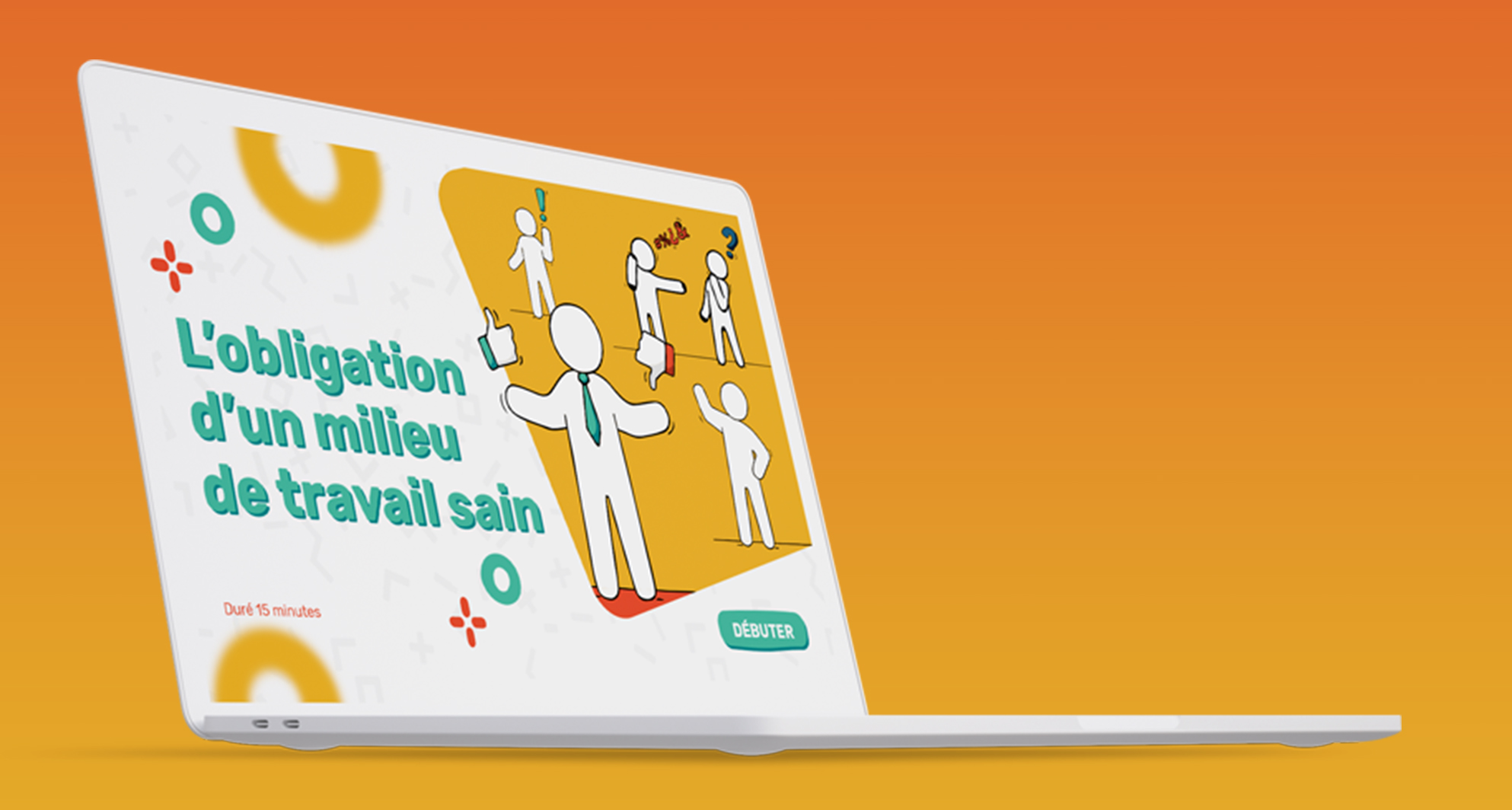
Civility at work matters; it's the law!
As of January 1 2021, federal companies are subject to new obligations, issued by the Canada Labour Code, in the fight against workplace harassment and violence. In accordance with this law, employers must guarantee their employees a work environment free from harassment and violence. This is another milestone toward civil work environments.
To support your teams in creating or maintaining a respectful work climate, we have developed online training designed to equip employees and managers for this purpose. Composed of 5 didactic microcapsules and a competency assessment capsule, the Civility at Work training course creates awareness that translates into a lasting change in interpersonal skills.